Staying invested is not the same as standing still.
Over a full market cycle, staying invested has built more wealth than moving in and out of the market. Timing requires being right twice: when to sell and when to buy back. The market’s strongest days tend to cluster immediately after its sharpest declines, so investors who step aside to avoid a drawdown often miss the recovery that follows.
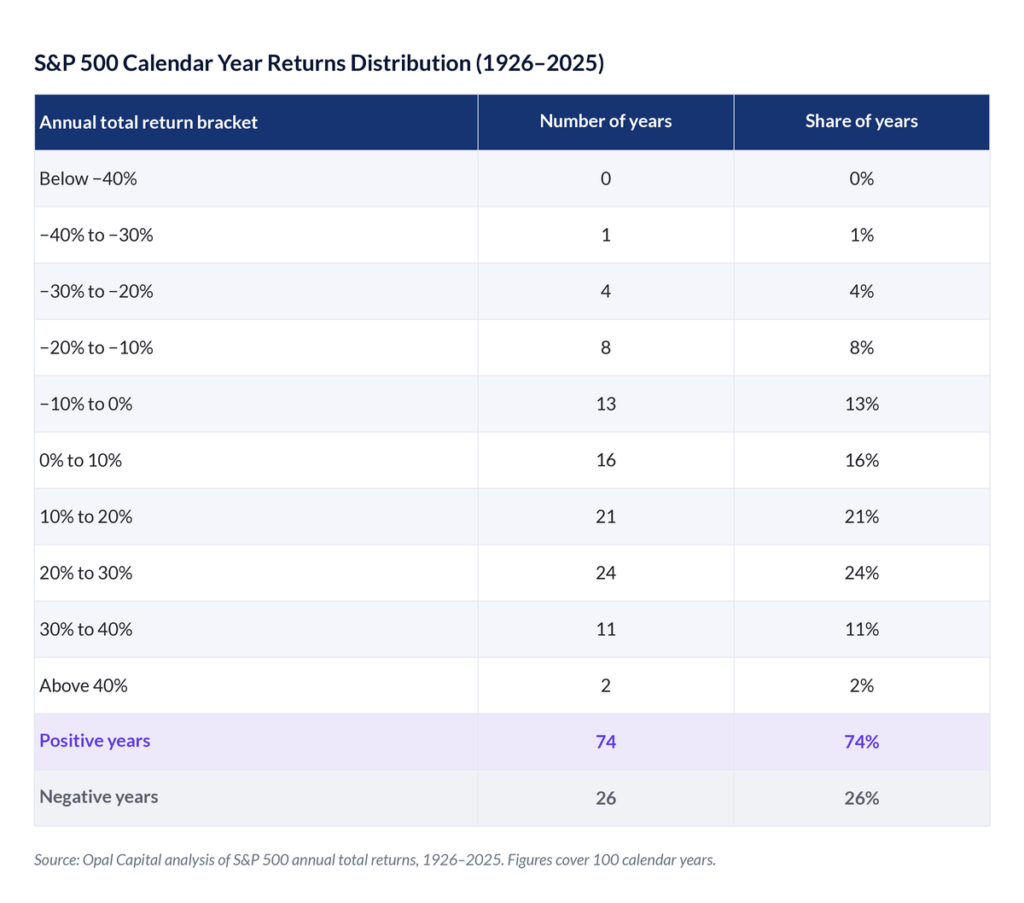
The long-run odds reward participation. Since 1926, the S&P 500 has produced a positive total return in roughly three of every four calendar years. The annual path is uneven, but over rolling 20-year periods a diversified equity allocation has very rarely ended in negative territory. Trying to dodge the down years means fighting those odds, and it usually means sitting in cash during the rallies that matter most.
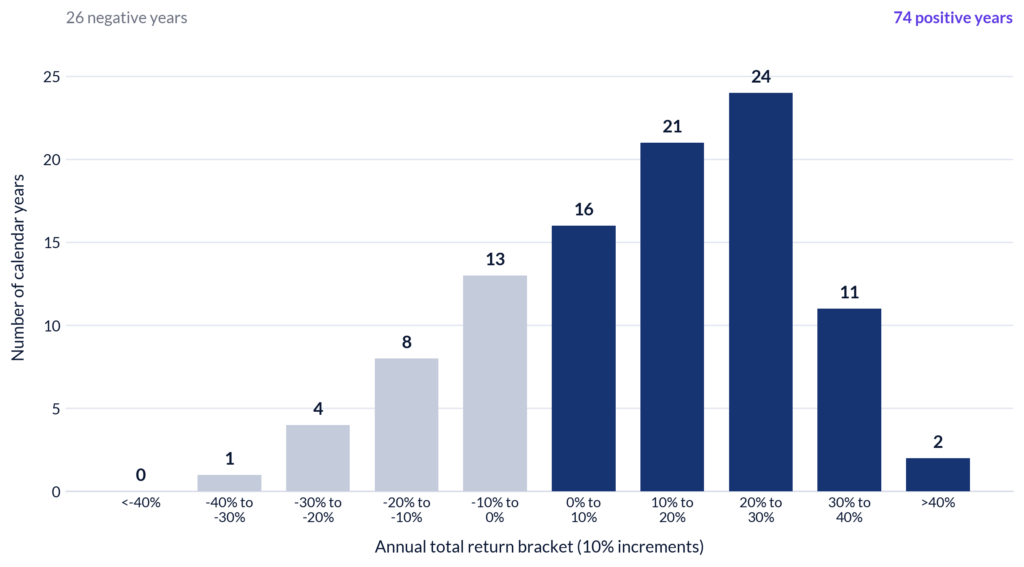
S&P 500 calendar year total returns, grouped into 10 percentage point brackets, 1926–2025.
Staying invested is not the same as standing still
The discipline worth keeping is remaining in the market rather than retreating to cash on sentiment. The decision worth making is where that capital is invested. Across a cycle, dislocations open between asset classes, between sectors, and among individual securities. Our models stay fully invested while continuously reallocating toward the most compelling fundamental opportunities at each stage of the cycle.
The role we fulfill for advisors
At Opal Capital, this is the role we fulfill on behalf of advisors. Identifying the best opportunities over a full market cycle, regardless of market sentiment or near-term conditions, is demanding and continuous work. By keeping portfolios fully invested and actively positioned, we help advisors keep their clients in the market with conviction, and free their time for the planning and relationships that depend on it.
INSTITUTIONAL RESOURCES. INDEPENDENT CONTROL.
Frequently asked questions
Is time in the market better than timing the market?
Over a full market cycle, staying invested has historically built more wealth than moving in and out. Market timing requires being right twice, on the exit and the re-entry, and the market’s strongest days often cluster right after its sharpest declines, so stepping aside risks missing the recovery.
What percentage of calendar years has the S&P 500 been positive?
Since 1926, the S&P 500 has finished the year higher about 74% of the time. On average, stocks have gained a little over 10% a year, and in 37% of years the gain topped 20%, more than double an average year. Put simply, holding stocks has been a great long-term bet: you win roughly three years out of four, and more than a third of the time you win big.
What happens if you miss the stock market’s best days?
The market’s best days tend to occur immediately after its worst, often during volatile recoveries. Investors who sell to avoid a downturn frequently sit in cash through the rebound, and missing even a small number of those days can meaningfully reduce long-term compounding.
Does staying invested mean never changing your portfolio?
No. Staying invested is not the same as standing still. The discipline is remaining in the market rather than retreating to cash. Where that capital is allocated should still change as opportunities shift across asset classes, sectors, and securities over the cycle.
How does Opal Capital help advisors stay invested through market cycles?
Opal’s models stay fully invested while continuously reallocating toward the most compelling fundamental opportunities at each stage of the cycle. This lets advisors keep clients in the market with conviction and frees their time for the planning and relationships their practice depends on.
ABOUT OPAL CAPITAL
Opal Capital is an independent RIA in Boca Raton, Florida that gives independent financial advisors an institutional-grade investment platform with modular components they can choose from.
This material is provided for informational and educational purposes only and does not constitute investment advice or a recommendation to buy or sell any security or to adopt any investment strategy. Past performance is not indicative of future results. All investing involves risk, including the possible loss of principal. Indices are unmanaged, do not reflect fees or expenses, and cannot be invested in directly. References to staying fully invested describe the objective of certain Opal models and are not a guarantee of any outcome.
© 2026 Opal Capital. All rights reserved.