The S&P 500 has continued its steady multi-year climb, gaining roughly 10% in the first six months of 2026. However, this surface-level stability masks a domestic equity market that is highly concentrated in a handful of companies. In the most recent quarter, we have seen the further spread of speculative behavior with respect to select technology companies, as well as a new wave of initial public offerings such as SpaceX.
A staggering 22 names within the S&P 500 have already doubled in price during the first six months of 2026. This narrow rally has been driven almost exclusively by a massive capital spending boom in artificial intelligence. In fact, Moderna is the only company out of these 22 breakout stocks that is not an AI play. When a small fraction of the index experiences such parabolic, vertical expansion, overall market fragility spikes. If the momentum behind these select few hyper-growth names suddenly reverses, the broader index faces significant downside risk.
The Warning From History: Irrational Exuberance
This rapid price acceleration serves as a stark reminder of the warning issued by former Federal Reserve Chair Alan Greenspan. In his iconic 1996 address, he famously posed a question that resonates profoundly with today’s top-heavy market dynamics:
The Warning From History: Irrational Exuberance
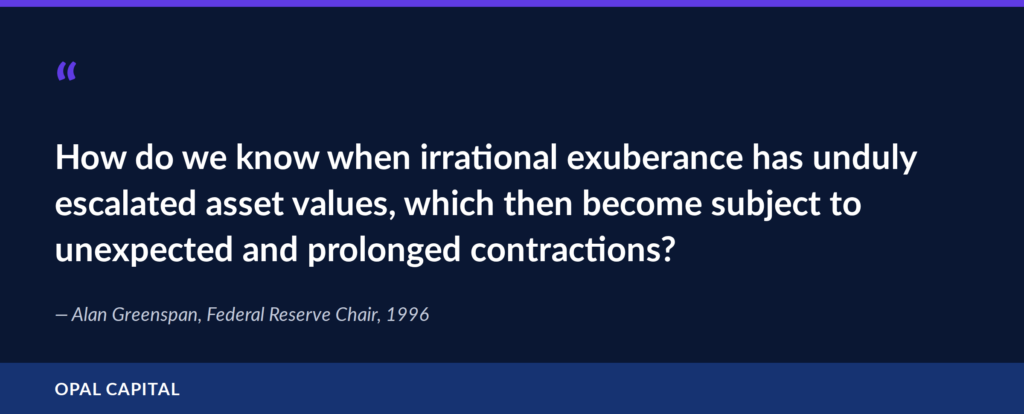
Greenspan’s insights highlight that when a handful of assets detach from historical fundamental valuations, a psychological contagion takes over. Historically, similar periods of acute market concentration have preceded painful valuation compressions.
Perspective on Extended Bull Markets
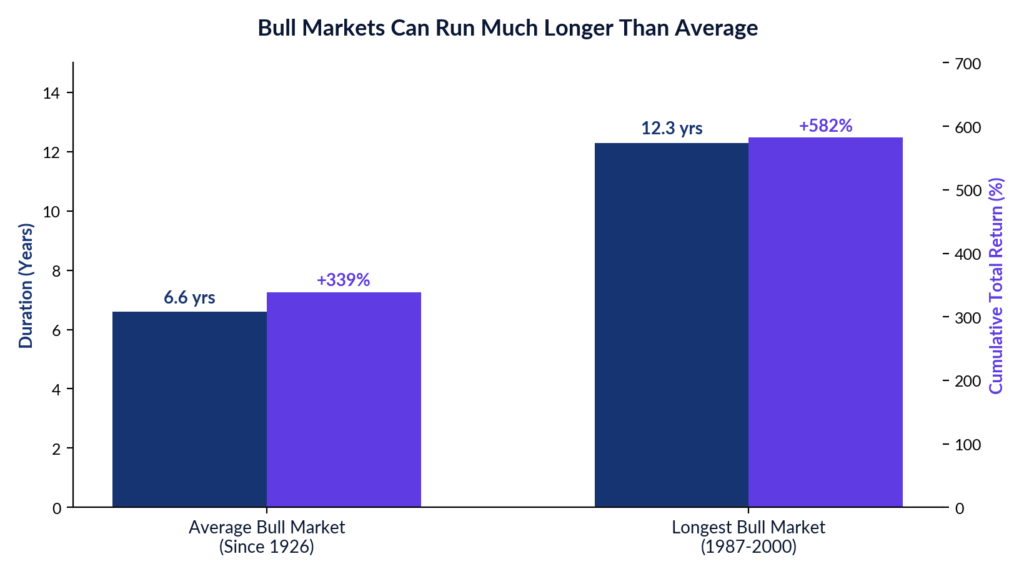
While concentration signals caution, history proves that extended bull markets can persist for remarkably long periods. Secular expansions rarely end simply because they have grown old. Data tracking U.S. cycles since 1926 illustrates the immense lifespan of market expansions. While the average bull market lasts 6.6 years and delivers a cumulative total return of 339%, history has seen much longer periods of gains. The longest bull market over the past 100 years ran for over 12 years, from 1987 to 2000, fueling a 582% gain before the dot-com crash.
Navigating Today’s Market Environment
In designing our process and philosophy, Opal Capital has intentionally taken a more conservative approach to help safeguard assets from near-term market pressures. Across multi-asset portfolios, we firmly recognize that time in the market, versus trying to time the market, is the most prudent path to compounding wealth. Missing the strongest days of an extended expansion can significantly damage long-term performance.
Within our actively managed equity portfolios, our objective is not to retreat to the sidelines in cash during periods of perceived high valuations, but to identify attractive, high-conviction companies structurally positioned to thrive. We are focusing on businesses with durable competitive advantages, healthy pricing power, and robust balance sheets that should prove valuable over a 3-to-5-year holding period, independent of short-term market gyrations.
How is your portfolio positioned for a market this concentrated? We’d welcome the conversation.
Frequently Asked Questions
Is the S&P 500 too concentrated in 2026?
By historical standards, yes. As of mid-2026, 22 companies in the S&P 500 had already doubled in price during the first six months of the year, and all but one, Moderna, are tied to artificial intelligence. This narrow leadership means a small group of stocks is driving a disproportionate share of the index’s returns, which increases fragility if that momentum reverses.
What did Alan Greenspan mean by “irrational exuberance”?
In a 1996 address, Federal Reserve Chair Alan Greenspan questioned how policymakers could recognize when asset prices had become detached from fundamentals due to excessive investor optimism, warning that such conditions can precede sharp, prolonged corrections. The phrase is now widely used to describe speculative excess in narrow or concentrated market rallies.
How long do bull markets typically last?
Since 1926, the average U.S. bull market has lasted about 6.6 years with a cumulative total return near 339%. The longest on record ran from 1987 to 2000, lasting over 12 years and delivering roughly a 582% gain before the dot-com crash, showing that concentration alone does not signal an imminent end to an expansion.
Should investors sell stocks during periods of high market concentration?
Opal Capital’s view is that investors should generally avoid moving to cash based on concentration concerns alone, since missing the strongest days of an extended expansion can meaningfully damage long-term returns. Instead, the firm favors identifying high-conviction companies with durable competitive advantages, pricing power, and strong balance sheets positioned to perform over a 3-to-5-year horizon.
About Opal Capital
Opal Capital is an independent RIA in Boca Raton, Florida that gives independent financial advisors an institutional-grade investment platform with modular components they can choose from.
This commentary is for informational purposes only and does not constitute investment advice or a recommendation to buy or sell any security. Past performance is not indicative of future results. All investments involve risk, including the possible loss of principal.
OPAL CAPITAL