Why the MSCI Emerging Markets Index has quietly become a concentrated bet on East Asian semiconductor manufacturing, and what that means for portfolio construction.
KEY TAKEAWAYS
- The top five countries in the MSCI Emerging Markets Index — Taiwan, South Korea, China, India, and Brazil — account for roughly 85% of the benchmark’s total weight.
- Three semiconductor companies — Taiwan Semiconductor, Samsung Electronics, and SK Hynix — make up close to 31% of the index on their own.
- Technology now represents approximately 45% of the index, leaving the benchmark exposed to a single global capital expenditure cycle in AI hardware.
- Opal Capital addresses this through active management and country-and-sector decoupling rather than relying on capitalization-weighted passive exposure.
Diversification remains a fundamental tenet of prudent investing. By combining assets with uncorrelated return patterns, investors can systematically reduce portfolio turbulence and mitigate single-country risk. Historically, allocating capital across geographic borders served as a reliable mechanism to capture global growth while insulating portfolios from domestic economic downturns.
The Modern Concentration Crisis
Today, achieving true geographic diversification is increasingly compromised by severe index concentration. While much attention is paid to the dominance of mega-cap technology stocks within the S&P 500, international benchmarks suffer from an identical systemic vulnerability. The Emerging Markets equity landscape serves as a stark example: a benchmark traditionally sought for broad, macroeconomic exposure across developing nations is now heavily dominated by a handful of systemic technology giants.
The Illusion of Broad Exposure
Passive investment in traditional EM indices no longer grants diversified exposure to localized economic growth. Just three semiconductor giants — Taiwan Semiconductor (TSMC), Samsung Electronics, and SK Hynix — together monopolize a staggering 30.89% of the entire benchmark.
Geographic concentration is equally lopsided, leaving the remaining nations marginalized within their own asset class. The index has become hyper-consolidated in East Asia and a handful of select hubs:
| Taiwan | 27.34% |
| South Korea | 23.72% |
| China | 19.03% |
| India | 11.09% |
| Brazil | 3.77% |
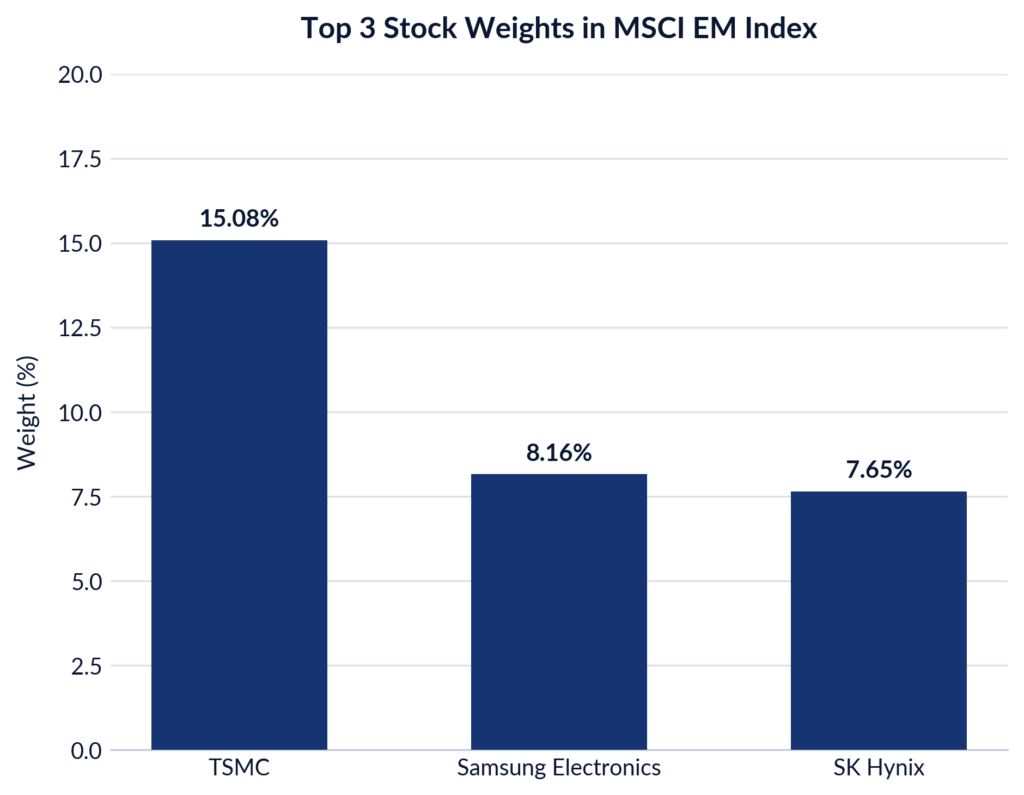
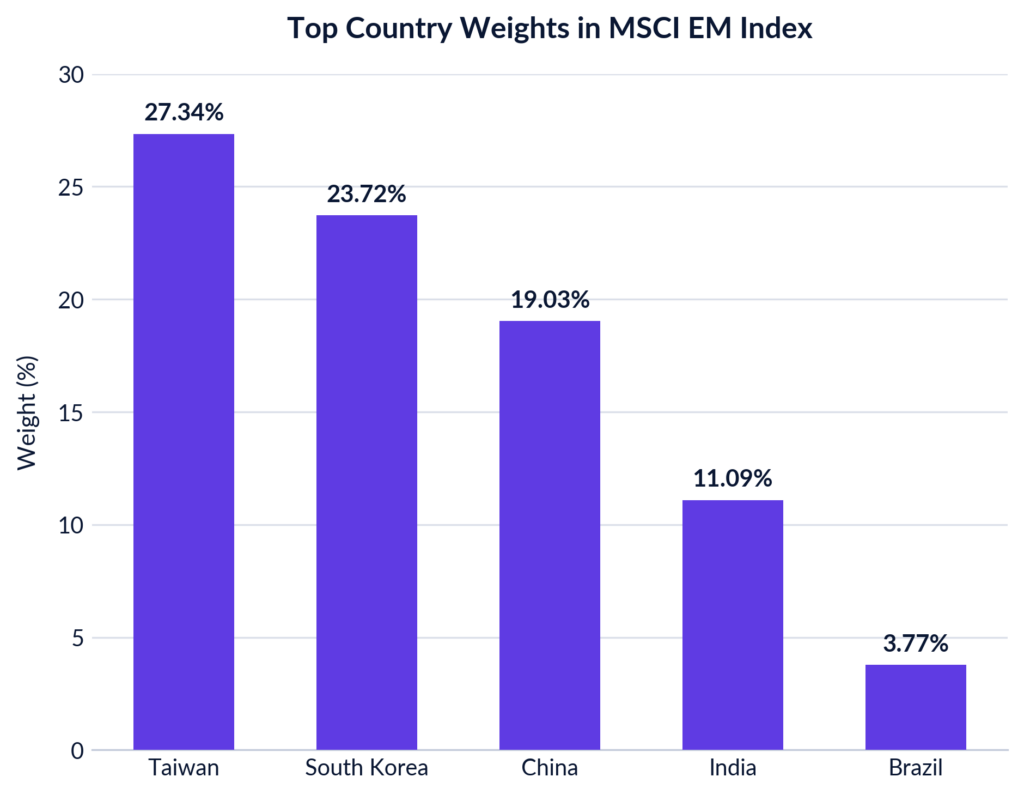
Top 3 stock weights and top country weights in the MSCI Emerging Markets Index, as of June 30, 2026. Source: MSCI EM (Emerging Markets) Index fact sheet, msci.com.
The top five countries alone account for nearly 85% of the entire EM index, leaving the remaining 19 nations to share a fractured 15% minority stake. Instead of a diversified bet on emerging consumer classes, passive investors are taking an incredibly top-heavy, structural wager on global artificial intelligence and semiconductor manufacturing supply chains. With both company and country concentration at these levels, the index ceases to function as a tool for broad economic diversification. Instead, passive investors are exposed to significant systemic macroeconomic risks that may not be evident at first glance.
Geographic Concentration Risk
When five countries command nearly 85% of a benchmark, the risks compound across several dimensions:
- The Hardware Corridor. With Taiwan and South Korea anchoring over 51% of the index weight, a significant portion of a passive portfolio’s risk is concentrated in a tight geographic cluster.
- Systemic Instability. Any escalation of cross-strait tensions involving Taiwan, or renewed instability on the Korean Peninsula, would not stay localized. It would immediately impair more than half of the EM benchmark’s value.
- Supply Chain Vulnerability. Because these countries dominate global semiconductor fabrication, a localized physical disruption or trade blockade could trigger a global technology freeze, pressuring the index’s largest components at the same time.
Monoline Macro Exposure: The AI and Hardware Cycle
Traditional emerging markets were sought out to capture cyclical commodity booms, infrastructure expansion, and surging domestic consumer sectors. Today, the index behaves more like a tech-heavy proxy fund. The technology sector’s exposure has climbed to account for roughly 45% of the index.
If global demand for artificial intelligence hardware experiences a cyclical downswing, or if corporate AI capital expenditure plateaus, the entire EM benchmark could face severe drawdowns. This dynamic leaves non-technology growth stories in regions like Latin America or Africa largely overshadowed by the hardware cycle.
Asymmetric Regulatory and Currency Pressures
- The Tri-Country Policy Trilemma. Because China, Taiwan, and South Korea carry the heaviest weightings, the regulatory decisions of just three governments can dictate the direction of the entire asset class.
- Currency Correlation. When capital flows exit the region due to local monetary changes or a strengthening U.S. dollar, the simultaneous depreciation of the New Taiwan Dollar, Korean Won, and Chinese Renminbi can disproportionately drag down the entire index, which nullifies much of the benefit of holding what should be independent, uncorrelated local currencies.
Restoring Portfolio Resilience
At Opal Capital, we recognize some of the issues that have complicated “old school” approaches to global investing. To navigate this shift, we believe portfolio managers and asset allocators must move beyond the headlines and understand how markets have changed in recent years. Restoring the true risk-mitigating power of global investing requires a deliberate shift toward:
- Active management. At Opal, our proprietary ETFs seek to identify differentiated, localized growth opportunities. Our process centers on a long-term focus on companies with management teams that have demonstrated consistent execution and fundamental business strategies capable of growing cash flow, earnings, and dividends across a full market cycle. While we do not manage an active emerging markets ETF, our developed markets strategy allows us to capture many of the benefits of global diversification.
- Granular country-and-sector decoupling to bypass structural index bottlenecks. At the core of our asset allocation and model construction process, we challenge conventional wisdom to understand cross-border risks that may not be visible at first glance. To address some of the issues we currently see within emerging markets, we have made a concerted effort to access similar growth rates with a different risk profile, through mid-cap domestic equities and other strategies designed to help advisors and clients work toward their goals.
Frequently Asked Questions
How concentrated is the MSCI Emerging Markets Index in 2026?
The top five countries — Taiwan, South Korea, China, India, and Brazil — together account for roughly 85% of the benchmark’s weight. Just three semiconductor companies — Taiwan Semiconductor, Samsung Electronics, and SK Hynix — make up close to 31% of the index on their own.
Which countries dominate the emerging markets index?
Taiwan represents about 27% of the index, followed by South Korea at roughly 24%, China at 19%, India at 11%, and Brazil at under 4%. The remaining 19 countries in the index share about 15% of total weight.
Does an emerging markets index fund still provide true diversification?
Passive exposure to a traditional emerging markets index increasingly functions as a concentrated bet on East Asian semiconductor manufacturing and global AI hardware demand, rather than a broad allocation across developing economies, which limits the diversification benefit investors typically expect.
How does Opal Capital address emerging markets concentration risk?
Opal Capital approaches concentration risk through active management and granular country-and-sector decoupling, seeking differentiated, localized growth opportunities rather than relying on capitalization-weighted index exposure. This can include accessing similar growth characteristics through mid-cap domestic equities and other strategies.
About Opal Capital. Opal Capital is an independent RIA in Boca Raton, Florida that gives independent financial advisors an institutional-grade investment platform with modular components they can choose from.
This commentary is for informational purposes only and does not constitute investment advice or a recommendation to buy or sell any security. Index constituent and country weighting data are sourced from the MSCI EM (Emerging Markets) Index fact sheet (msci.com) and are subject to change as the index is rebalanced. Past performance is not indicative of future results. All investments involve risk, including the possible loss of principal. International and emerging markets investing involves additional risks, including currency fluctuation, political and economic instability, and differences in financial reporting standards.