
Opal Capital | October 2026
KEY TAKEAWAY
In 2025, 7% of ETFs paid a capital gain distribution, compared with 52% of mutual funds, according to State Street Investment Management’s analysis of Morningstar data. For long-term investors in taxable accounts, the ETF structure means capital gains taxes depend less on other shareholders’ trading and more on the investor’s own decision about when to sell.
During the past several years, ETFs have gained recognition as an alternative to traditional mutual funds. U.S. ETF assets reached $13.4 trillion at the end of 2025, up from $2.5 trillion at the end of 2016, according to the Investment Company Institute.1 While both vehicles can help you diversify a portfolio by giving you a basket of investments with one purchase, they are structured differently. One of the most distinct features of ETFs is that trading occurs throughout the day, similar to stocks. This can be helpful if you want more control over timing and price. Mutual fund orders are executed once a day, all at the same price.
Along these lines, Opal Capital clients often ask what role ETFs play in our model portfolios and why we prefer them to traditional mutual funds. Trading flexibility and transparency are positive attributes, but a larger driver is the potential for greater tax efficiency for long-term investors.
Why can a mutual fund leave you with a tax bill you didn’t expect?
Because of these structural differences, mutual fund investors with taxable accounts may face an unwelcome year-end surprise: a capital gain distribution, and the resulting tax bill, even if they did not sell any shares. Reinvesting the distribution does not change that. In a taxable account, capital gain distributions are generally reportable whether they are received in cash or reinvested in additional shares.4
This is not a rare occurrence. State Street Investment Management’s analysis of Morningstar data found that 52% of mutual funds paid a capital gain distribution in 2025, compared with 7% of ETFs.2 Nor was 2025 unusual: since 2016, an average of 53% of mutual funds have distributed gains each year, versus 9% of ETFs.2
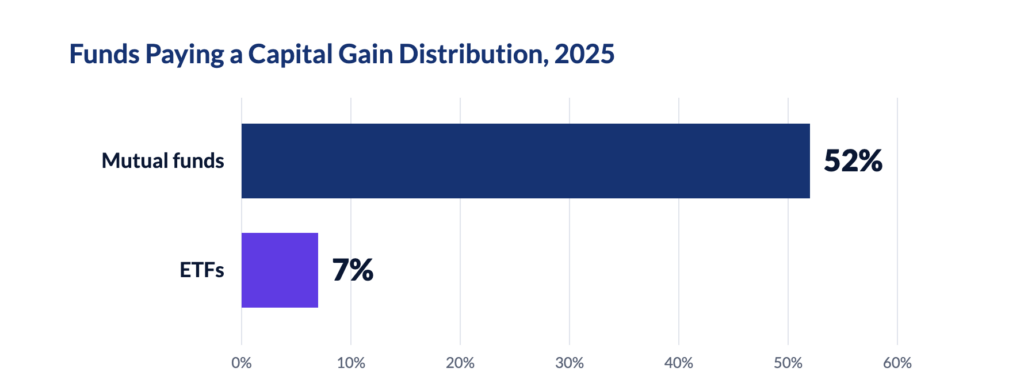
ETFs can offer buy-and-hold investors in taxable accounts a distinct tax advantage. Their structure can reduce capital gain distributions, so an investor’s annual capital gains tax exposure depends less on other shareholders’ trading and more on the investor’s own decision about when to sell. This gives investors greater control over when gains are realized and taxes are due.
Why is the ETF structure more efficient for taxable investors?
The difference comes down to what happens when other investors sell. When mutual fund shareholders redeem their shares, the portfolio manager may need to sell securities to raise cash. If those sales generate net capital gains, those gains may be distributed across the fund’s remaining shareholders. Managers may also sell securities as they adjust the portfolio. In other words, another shareholder’s action can potentially create a taxable event for you, even though you stayed invested.
ETF shares, by contrast, are typically bought and sold between investors on an exchange, without requiring the portfolio manager to transact in the underlying securities. When larger redemptions do reach the fund, ETFs can often transfer securities “in kind” to an authorized participant rather than selling them for cash. The SEC’s investor guidance notes that because many ETFs use these in-kind exchanges, they typically have fewer capital gains distributions than mutual funds.3
Active managers may also be able to use the in-kind mechanism when repositioning portfolio holdings. The data reflects this: in 2025, 9% of active ETFs paid a capital gain distribution, compared with 53% of active mutual funds.2 With ETFs, investors have more control of their own journey.
That said, tax-efficient does not mean tax-free. ETFs can still distribute income and capital gains, and selling appreciated shares can generate a gain. The advantage also varies by strategy: ETFs that use certain derivatives or invest in markets that restrict in-kind transfers may distribute more often, and some low-turnover index mutual funds are tax-efficient as well.
How do ETFs and mutual funds compare for taxable investors?
| ETFs | Mutual funds | |
|---|---|---|
| How shares trade | Throughout the day on an exchange, at market prices | Once a day, at net asset value after the market closes |
| When another investor sells | Shares typically change hands on the exchange; the fund does not need to sell holdings | The fund redeems the shares and may need to sell holdings to raise cash |
| How large redemptions are met | Often in kind, by transferring securities to an authorized participant | Typically in cash, which may require selling securities |
| Funds paying a capital gain distribution in 2025 | 7%2 | 52%2 |
| Tax difference in an IRA or 401(k) | None, according to the SEC3 | |
Does this matter in an IRA or 401(k)?
These distinctions are most important in taxable accounts. In tax-deferred accounts such as a traditional IRA or 401(k), investment earnings and gains generally are not taxed as they occur. Instead, taxable withdrawals are generally subject to ordinary income tax, and qualified Roth IRA withdrawals are tax-free. As the SEC puts it, there is no tax difference between an ETF and a mutual fund held in a tax-advantaged account.3
What does this mean for investors?
For investors in taxable accounts, ETFs can reduce exposure to fund-level capital gain distributions and allow tax outcomes to follow their own buying and selling decisions. With mutual funds, tax liabilities can be less predictable, because they may depend on the selling activity of other fund shareholders.
At Opal Capital, we place a high priority on managing portfolios in a tax-efficient manner. For long-term investors, the mantra should include not only what you earn, but also what you keep net of taxes. The incorporation of ETFs and their tax benefits is one way we pursue this goal.
Learn how Opal Capital approaches tax-aware portfolio management for independent advisors.
Frequently Asked Questions
Are ETFs more tax-efficient than mutual funds?
Generally, yes, for investors in taxable accounts. Because many ETFs meet large redemptions by transferring securities in kind rather than selling them, they typically make fewer capital gain distributions. In 2025, 7% of ETFs paid a capital gain distribution, compared with 52% of mutual funds, according to State Street Investment Management’s analysis of Morningstar data.
Why did my mutual fund pay a capital gain distribution if I didn’t sell any shares?
When other shareholders redeem, or when the manager repositions the portfolio, the fund may sell securities at a gain. Mutual funds generally distribute net realized gains to the shareholders who remain, so investors in taxable accounts can owe tax on a distribution even if they never sold.
Do I pay taxes on reinvested capital gain distributions?
Generally, yes. In a taxable account, capital gain distributions are generally reportable whether they are received in cash or automatically reinvested in additional fund shares.
What is an in-kind redemption?
An in-kind redemption occurs when an ETF meets a large redemption by transferring a basket of underlying securities to an authorized participant instead of selling those securities for cash. Because the securities are not sold, the fund generally does not recognize a taxable gain on them.
Do ETFs ever pay capital gain distributions?
Yes. Tax-efficient does not mean tax-free. ETFs can still distribute income and capital gains, particularly strategies that use certain derivatives or invest in markets that restrict in-kind transfers. Investors also owe tax on gains when they sell appreciated ETF shares.
Does ETF tax efficiency matter in an IRA or 401(k)?
Much less. According to the SEC, there is no tax difference between an ETF and a mutual fund held in a tax-advantaged account such as an IRA or 401(k). The structural advantage matters most in taxable brokerage accounts.
About Opal Capital
Opal Capital is an independent registered investment adviser based in Boca Raton, Florida. The firm provides an institutional-grade investment platform with modular components for independent financial advisors.
Sources
- Investment Company Institute | 2026 Investment Company Fact Book: Quick Facts Guide | ici.org
- State Street Investment Management | Tax Efficiency Is Structural: ETFs Continue to Issue Fewer Capital Gains Than Mutual Funds | February 18, 2026; Morningstar data as of December 31, 2025 | ssga.com
- U.S. Securities and Exchange Commission, Investor.gov | Characteristics of Mutual Funds and Exchange-Traded Funds | April 29, 2025 | investor.gov
- Fidelity | Understanding Mutual Fund Taxes | fidelity.com
This material is for informational purposes only and is not tax, legal or investment advice. Investors should consult a tax professional regarding their specific situation. Investing involves risk, including possible loss of principal. Data cited is from third-party sources believed to be reliable but not independently verified by Opal Capital.