Where markets stand at the midpoint of 2026, and what it means for investors.
KEY TAKEAWAYS
- U.S. stocks have stayed resilient through the first half of 2026 despite trade, policy, and geopolitical pressures.
- The rally has broadened beyond the largest technology names, with smaller-company stocks rebounding from their spring lows.
- Strong corporate earnings, including record first-quarter margins, remain the market’s firmest support.
- Consumer spending and tax relief continue to help, but reaccelerating inflation has narrowed expectations for further Fed rate cuts.
- For investors, discipline tends to outperform prediction: review plan alignment, rebalance drift, and deploy excess cash gradually.
MARKETS STAY RESILIENT THROUGH A TURBULENT FIRST HALF
U.S. stocks have stayed resilient through the first half of 2026, even as trade disputes, shifting policy expectations, and geopolitical risk have driven periods of turbulence. The U.S.-Iran ceasefire has eased some pressure on energy markets and supported investor sentiment, though uncertainty remains around negotiations and the pace at which commercial shipping through the Strait of Hormuz can normalize.
A BROADER RALLY BEYOND THE LARGEST COMPANIES
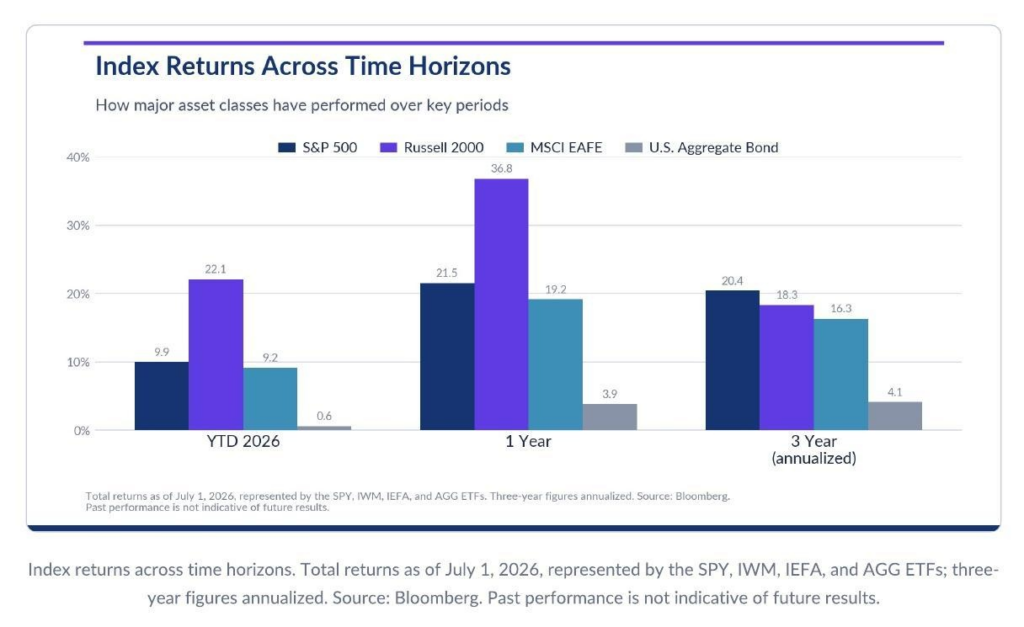
Even so, the rally has broadened well beyond the market’s largest companies. Smaller-company stocks have rebounded sharply from their spring lows and have outpaced large-cap benchmarks for much of the year, a sign of improving confidence and wider participation across sectors. Broader participation is reassuring, because gains are no longer concentrated in a narrow group of large technology names. It also warrants some caution, as parts of the small-cap market now trade at elevated valuations relative to history.
CORPORATE PROFITS REMAIN THE MARKET’S STRONGEST SUPPORT
Corporate profits remain the strongest support for the market. S&P 500 companies delivered exceptionally strong first-quarter results, with the large majority beating both earnings and revenue expectations and profit margins reaching record levels. That strength helps explain why investors have kept buying stocks despite higher oil prices, tariff uncertainty, and persistent geopolitical risk.
CONSUMER DEMAND AND TAX POLICY
Consumer demand continues to provide an important foundation for the market. Personal consumption rose in April, though higher inflation absorbed much of the gain in real terms. Even so, steady household spending suggests consumers remain active despite higher energy prices and policy uncertainty.
Tax relief and earlier interest rate cuts have helped sustain the expansion. Lower corporate and individual taxes, together with notably larger federal tax refunds this filing season, have supported household finances, while the Federal Reserve’s prior rate cuts encouraged borrowing and spending. Together, these factors give investors reason to maintain a constructive outlook.
At the same time, the policy picture has grown less certain. Inflation has reaccelerated in recent months, due in part to the spring rise in energy prices, and that has reduced expectations for further rate cuts. Markets now anticipate that the Fed may keep rates higher for longer if price pressures persist.
THE VIEW FROM MID-YEAR
The 2026 outlook remains constructive, but meaningful risks persist. Consumer spending, business investment, strong earnings growth, tax relief, and earlier Fed rate cuts continue to support stocks. At the same time, elevated valuations, tariffs, renewed inflation, geopolitical tension, and election-year uncertainty could test confidence and add short-term turbulence.
Investors are likely to be served better by discipline than by prediction. A practical approach begins with reviewing whether each portfolio still aligns with the investor’s goals, time horizon, and tolerance for market swings. From there, investors may consider rebalancing if allocations have drifted and putting excess cash to work gradually rather than all at once.
This keeps the focus on long-term plan alignment rather than the daily headline cycle. Market turbulence can be uncomfortable, but for investors with clear plans and diversified portfolios it can also create opportunity. A thoughtful portfolio review can help separate temporary market noise from the developments that may truly affect the long-term outlook.
FREQUENTLY ASKED QUESTIONS
What is Opal Capital’s 2026 mid-year market outlook?
Our outlook for the second half of 2026 remains constructive but mindful of risk. Consumer spending, business investment, strong earnings, and tax relief continue to support stocks, while elevated valuations, tariffs, reaccelerating inflation, and geopolitical tension could add short-term turbulence.
Why has the stock market been resilient in 2026?
The strongest support has been corporate profits. S&P 500 companies posted strong first-quarter results, with the large majority beating earnings and revenue expectations and margins reaching record levels. Steady consumer spending and earlier interest rate cuts have also helped.
Has the stock market rally broadened in 2026?
Yes. Gains are no longer concentrated in a small group of large technology companies. Smaller-company stocks have rebounded sharply from their spring lows and outpaced large-cap benchmarks for much of the year, a sign of wider participation across sectors.
How is inflation affecting Federal Reserve rate cut expectations?
Inflation has reaccelerated in recent months, due in part to higher energy prices. That has reduced expectations for additional rate cuts, and markets now anticipate the Fed may keep rates higher for longer if price pressures persist.
What should investors do in the second half of 2026?
A practical approach favors discipline over prediction. Start by reviewing whether your portfolio still aligns with your goals, time horizon, and tolerance for market swings, then consider rebalancing if allocations have drifted and putting excess cash to work gradually.
ABOUT OPAL CAPITAL
Opal Capital is an independent RIA in Boca Raton, Florida that gives independent financial advisors an institutional-grade investment platform with modular components they can choose from.